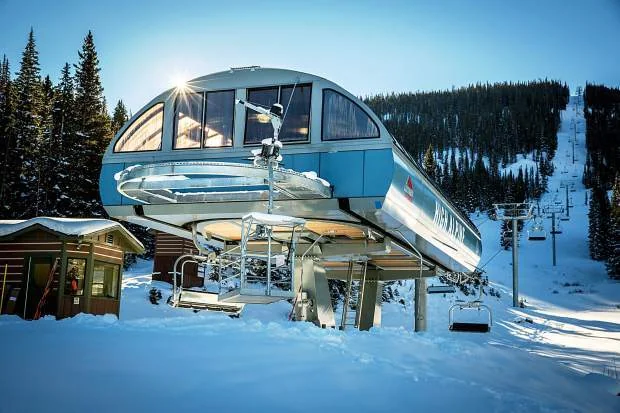
At the top of the Sheer Bliss six-pack, most skiers unload, look around, and head back down. A smaller group keeps going. They traverse hard skier’s-right, click into the Cirque T-bar — Snowmass’s newest surface lift, installed for the 2025-26 season as a replacement for the 28-year-old Cirque Poma — and ride it up into what feels like a different mountain entirely. Where the T-bar drops you — at 12,510 feet — is the highest lift-served point at Snowmass and one of the highest at any ski resort in Colorado. What’s up there is worth the trouble.
The Cirque T-bar: Colorado’s Highest Lift Ride
The Cirque T-bar is a surface lift — two riders stand side by side, with a bar across the back of their thighs pulling them up. It replaced the long-running Cirque Poma for the 2025-26 season after the Poma completed 28 years of service. The new T-bar is a Leitner/Skytrac build, ride time just under six minutes, and roughly double the old Poma’s uphill capacity at 1,000 guests per hour. If you fall off in the first thirty feet — common on any surface lift above 12,000 feet — step off to the side, let the line pass, and try again.
A few pointers from locals: Keep your skis parallel and pointed straight up the fall line. Don’t sit on the bar; let it push the back of your thighs while you stand on your skis. Breathe. You’re above 12,000 feet now — the lift ride itself will leave you winded if you’re not acclimated.
The Cirque T-bar is seasonal and wind-dependent. It typically opens by mid-to-late December once the upper mountain has enough snow, and it closes when winds exceed operational limits — which, at 12,510 feet in a high alpine bowl, happens regularly. Check the lift status before you make the traverse from Sheer Bliss. There’s nothing worse than earning the ride to find the lift on hold.
What’s at the Top
Step off the T-bar and you’re standing on a narrow ridge at the top of the Cirque, looking down into a glacial bowl surrounded by the high peaks of the Elk Range. Capitol Peak and the Maroon Bells are visible on clear days. Mount Daly sits directly across the valley. The air is thinner than almost anywhere else you can ski in North America without hiking.
From the summit, your options fan out along the ridge into the Cirque’s expert chute system. Skier’s-right opens up Gowdy’s, AMF, and the double-black chutes of the Cirque proper. Long Shot — often mistakenly associated with the Cirque — is a separate run accessed from the top of the Elk Camp chair via a short hike; we cover it in its own guide.
The Lines
AMF is an acronym skiers invent translations for — the clean version is “Adios, My Friend.” AMF drops off the Cirque ridge into a wide open face that funnels into a narrower chute below. On a clean powder day, it’s one of the best lines on the mountain. On a wind-scoured day, it’s ice and chalk and sharp edges.
Gowdy’s is a classic Cirque chute line — steep, committing, and usually holding some of the best snow in the zone because its aspect keeps it out of the sun. Named for Curt Gowdy, the sportscaster who helped popularize Aspen Snowmass in the early resort era.
Baby Ruth, The Roof, Juggernaut and the rest of the named Cirque chutes are all double-black and all varying degrees of serious. Rocky entrances, narrow slots, mandatory airs in some conditions. If you don’t recognize these names from talking to patrol or local skiers, consider asking before you drop in. Every chute has its own quirks and some have entrances that are harder than the skiing below.
Conditions and Timing
The Cirque skis best on cold, clear days two to three days after a storm. Avalanche control takes time to complete in an alpine bowl — the Cirque often opens later than the rest of the mountain on storm days, sometimes not at all. Wind at 12,500 feet loads some aspects and scours others; a day or two after the storm lets wind patterns stabilize. And the powder tracks out slowly because the hike-plus-T-bar barrier keeps skier density low — even on busy weekends, the Cirque sees a fraction of the traffic of the groomers.
First tracks in the Cirque often happen around 10 or 11 a.m. on a post-storm day, not the 8:30 bell. Watch for the Cirque T-bar status to flip from “hold” to “open,” then make the traverse from Sheer Bliss with urgency. The good lines get skied fast once the gate drops.
Altitude Reality Check
At 12,510 feet, everyone feels it. Even Colorado locals who live at 8,000 feet will notice the Cirque. If you’ve flown in from sea level in the last 48 hours, plan the Cirque for later in your trip. Start with the Big Burn and Elk Camp on day one, let your body acclimate, and save the Cirque for day three or four.
Signs the altitude is catching up with you: headache, nausea, unusual fatigue on the lift, shortness of breath that doesn’t ease with rest. Any of those and the right move is to ski down, hydrate, eat, and save the Cirque for another day. The mountain will still be there tomorrow.
Who the Cirque Is For
Advanced and expert skiers with the skills to handle variable high-alpine conditions. Not a zone for “advanced-intermediates.”
Photographers and view-seekers. The summit of the Cirque T-bar has arguably the best lift-accessed view in Colorado. Even if you don’t drop into the steeps, taking the T-bar up on a bluebird day is worth it just for the ridge walk and the panorama.
Ski Home to Stonebridge
The Cirque’s expert lines drop cleanly into the High Alpine base. From there, it’s a ride up High Alpine and a cruise down through the Big Burn, Sheer Bliss, and Fanny Hill — and you’re back at your door at Stonebridge. Our ski-in, ski-out location means a Cirque day ends with a few yards of easy skiing to your building, not a shuttle ride. After the altitude and the chutes, that matters more than almost anything else.
Ready to plan a Snowmass trip built around earning the view from 12,510 feet? Reserve your Stonebridge condo or call us at 1-800-323-2577. We’ll match you with the right unit for your group and your skiing style.