
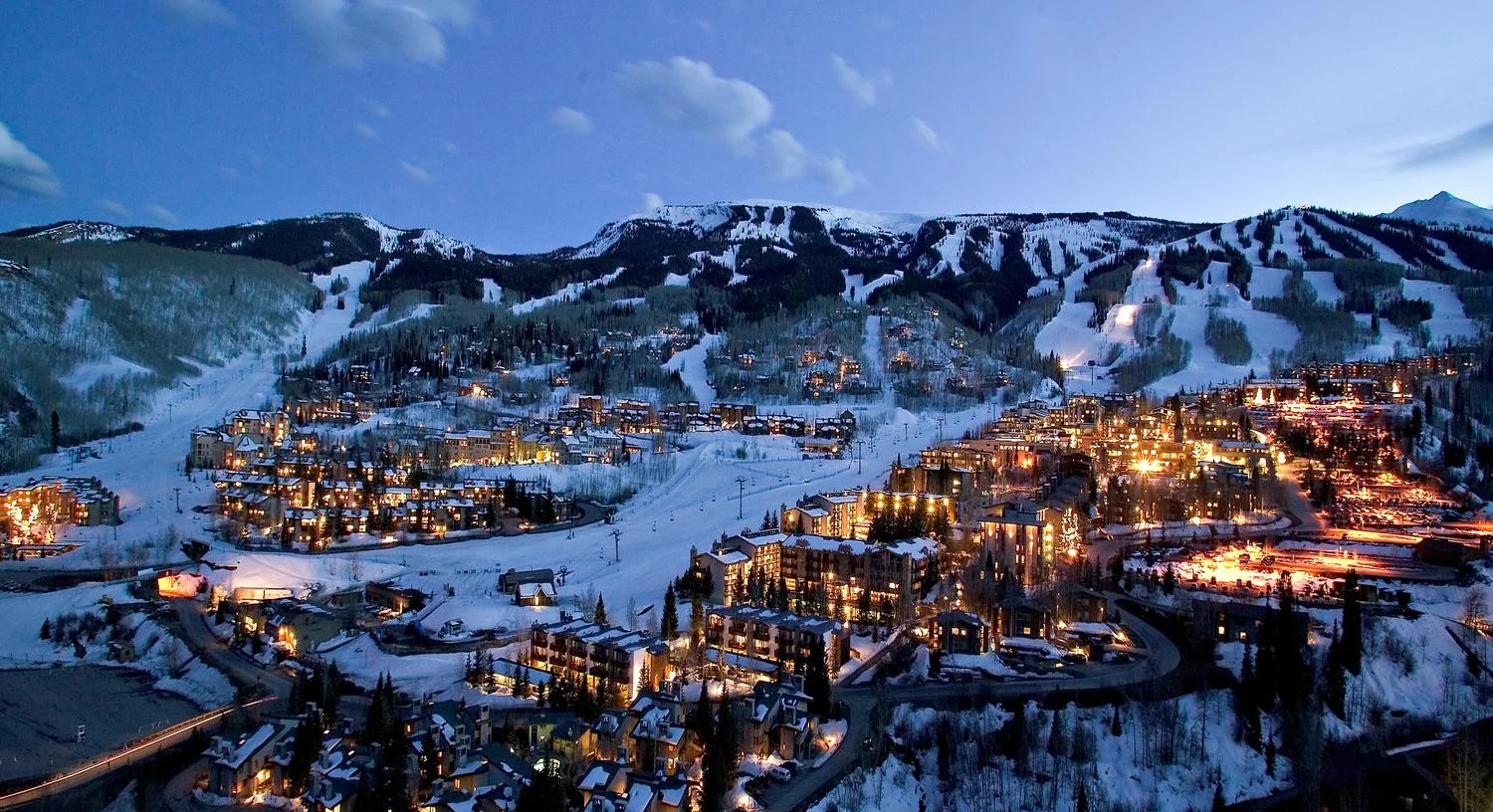
Ask a hundred Snowmass regulars what their favorite part of the mountain is, and most of them will say the same two words: the Burn. The Big Burn is the heart of Snowmass — 600 acres of wide-open intermediate pitches studded with evenly-spaced spruce trees, the kind of terrain that flatters every skier who touches it. It’s the pod that turns good skiers into confident skiers and confident skiers into fast ones. If you ski only one part of Snowmass, this is the part you ski.
A 19th-Century Forest Fire, Still Paying Dividends
The Big Burn gets its name honestly. Local history holds that Ute tribes set the hillside on fire sometime in the 1880s, clearing thousands of acres of dense forest and leaving behind the evenly-spaced tree pattern that defines the terrain today. Whatever actually happened, the result is one of the most unusual natural ski features in North America: a broad, open bowl that behaves like above-treeline terrain but sits at a friendly 10,000-foot elevation with widely-spaced spruce instead of tundra. No eastern mountain has anything like it. Few western mountains do either.
The spacing between trees is the secret. On most wooded pitches in Colorado, skiing off the groomers means committing to real tree skiing — tight lines, quick turns, consequences. On the Big Burn, the trees are far enough apart that you can carve long, open turns between them and feel like you’re skiing the steeps of a powder day even on a mellow blue run.
Lifts and Layout
The Big Burn is served by two primary lifts:
Sheer Bliss is a high-speed six-pack climbing from the top of Fanny Hill to 11,030 feet. It delivers you to the skier’s-right edge of the Big Burn and also provides access to the Cirque Poma above. This is the lift you’ll want for top-to-bottom lapping.
Big Burn is a high-speed quad rising from a mid-mountain load station to the same general summit ridge. It serves the middle of the pod directly and is often faster-loading than Sheer Bliss on busy mornings.
Between the two lifts, the Big Burn handles crowds better than almost any zone on the mountain. Even on holiday weekends, the sheer width of the terrain absorbs skier traffic. You can ski a dozen laps and never feel like you’re fighting for a line.
The Runs: A Top-to-Bottom Breakdown
The Big Burn’s named runs are more like suggestions than boundaries — the whole pod skis as one. That said, here’s what each line offers.
Dallas Freeway is the most popular groomed run in the pod and the one most intermediates default to first. Wide, consistently-pitched, and groomed daily, it’s the perfect warm-up lap and a legitimate cruiser for any skill level.
Sneaky’s drops off the skier’s-left side of the Burn into a more sheltered pocket. It’s slightly steeper than Dallas Freeway, holds snow better on warm afternoons, and often goes untouched long after the rest of the pod has been lapped.
Powerline Glades is exactly what the name suggests — lightly gladed intermediate terrain that lets you practice tree skiing with a safety net. If you’ve never skied trees before, this is where you learn. The pitch is forgiving and the spacing is wide.
Glissade and Whispering Jesse are the lower-pod runs that funnel skiers back toward the Sheer Bliss base. Both are classic Colorado blue runs — rolling, consistent, and long enough to build real speed if you’re up for it.
Mick’s Gully drops off the skier’s-right side of the pod into a steeper, more contained line. It’s marked blue but skis like a mellow black, especially after a storm when the wind-loaded snow piles up against the gully walls.
Powder Day Strategy
The Big Burn is not the first place experts head on a powder morning — the steeper terrain off High Alpine and the Cirque gets first tracks attention. That’s exactly why the Burn is where you want to be.
The wide tree spacing means fresh tracks stay available long after the groomed runs have been skied out. The pitch is mellow enough that you can ski light, feathery powder turns without needing the gravity of steeper terrain. And because most of the expert crowd has pushed uphill to the Cirque Poma, the Burn itself stays surprisingly uncrowded for the first few hours of a storm day.
The local move: let the first chair crowds race for the Cirque, take a leisurely coffee, load Sheer Bliss around 9:30, and spend the morning lapping knee-deep snow between the spruce trees while the hardcore crowd stands in line above you.
Sam’s Smokehouse
A guide to the Big Burn isn’t complete without Sam’s Smokehouse, the mid-mountain lodge that sits at the top of Sam’s Knob with a direct ski connection to the Burn. Sam’s is a no-frills BBQ stop — brisket, pulled pork, chili, beer — with a massive deck that catches the midday sun. On bluebird days, half the mountain ends up at Sam’s by 12:30. Arrive at noon or after 1:30 if you want a table without waiting.
Who the Big Burn Is For
Strong beginners transitioning to blues. The pitch is forgiving enough that a confident green-run skier can handle Dallas Freeway on day two or three of a trip. The trees provide visual reference points that make learning speed control easier than on a featureless open slope.
Intermediates who want to ski fast. This is what the Big Burn was built for. Carve long turns, let the skis run, repeat all day.
Advanced skiers on powder mornings. Skip the Cirque line. Ski the Burn in peace.
Families skiing together. The Burn’s width accommodates groups at different paces. Faster skiers can bomb Dallas Freeway while slower members cruise Glissade, and everyone regroups at the Sheer Bliss or Big Burn base.
Ski Home to Stonebridge
Every lap on the Big Burn ends with the same question: where’s lunch, and where’s the hot tub? At Stonebridge Condominiums, both are a ski-length away. Our true ski-in, ski-out location on Fanny Hill means you finish your last Burn lap, glide down Fanny, and step out of your skis at your building’s door. No shuttle, no parking lot walk, no wet ski boots in a rental car. Just your condo, your fireplace, and your hot tub waiting.
Ready to plan a Snowmass trip built around lapping the Big Burn? Reserve your Stonebridge condo or call us at 1-800-323-2577. We’ll match you with the right unit for your group and your skiing style.